
the cult doc plot
Trust Me: The False Prophet on Netflix


💎Diamond medallion members:💎 if you missed my conversation with literary agent Joanna MacKenzie on Friday, the video is available to watch for a few more days!
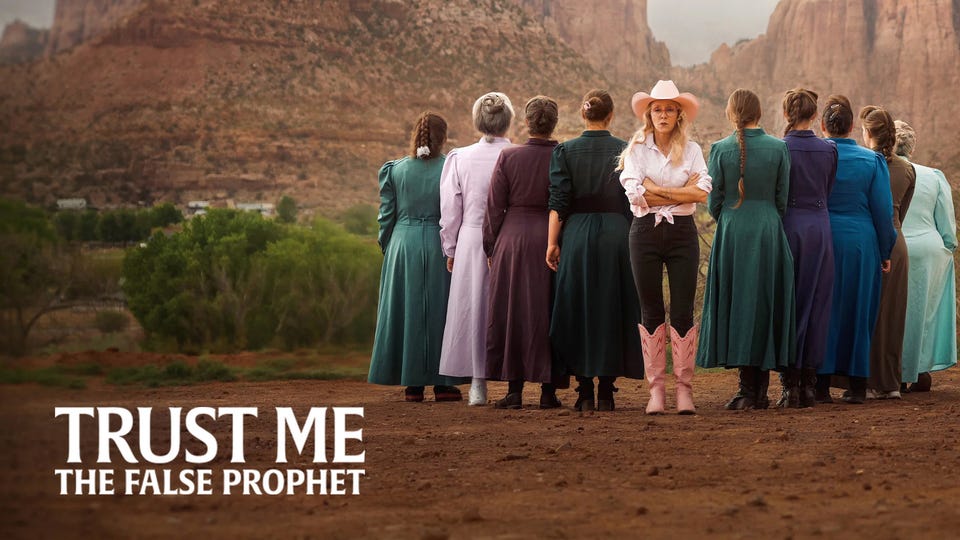
This week, Netflix released its 6,735,256th true crime doc, with all your favorite tropes: religious fundamentalism, modest wear, panoramic shots of the American West, a Very Bad Man, and victimized young white women (and girls).
As I binged the entire four-part series last night, I realized that the reason I was so moved by Trust Me was not because of the harrowing details of the crimes, but by the plot of the documentary, and the extraordinary conditions under which it was created.
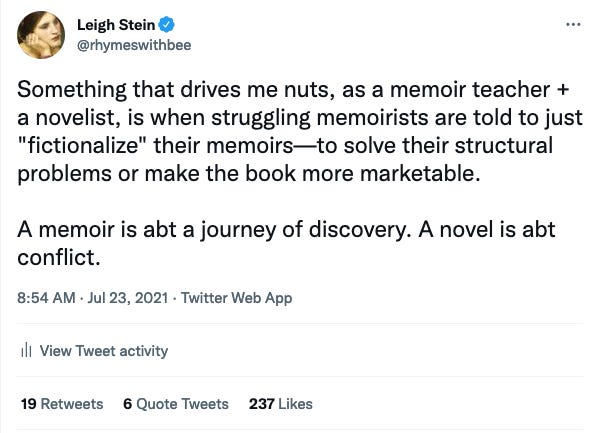
“Plot” is a strange word to apply to narrative nonfiction because plot is a storyteller’s invention. It is the novelist’s job to entertain a reader by building a 300-page rollercoaster of drama and conflict. Nonfiction authors (including memoirists) must also be good storytellers, but they are constrained by chronology and reality. We read (and watch) nonfiction not only to find out what happened—but to understand what it meant. A nonfiction book (or documentary) must go beyond a faithful recitation of events, even if the events themselves are shocking. When you’re writing a nonfiction book proposal, you have to be able to answer the question, “So what?” (So what that it really happened?)
Whether you are a novelist or a memoirist, I think Trust Me is worth watching and studying because the filmmakers use plot structure techniques that help set the film apart from most other docs in its category.
Make the most fascinating character your hero
A good plot requires a hero who acts instead of who is acted upon. In true crime docs, a law enforcement officer is often the hero, though sometimes it can be a citizen sleuth, like Michelle McNamara in I’ll Be Gone in the Dark.
John Truby, the leader of my personal plot cult, says:
Always tell a story about your best character.
“Best” doesn’t mean “nicest.” It means “the most fascinating, challenging, and complex,” even if that character isn’t particularly likable. The reason you want to tell a story about your best character is that this is where your interest, and the audience’s interest, will inevitably go. You always want this character driving the action.
The way you determine the best character embedded in the idea is to ask yourself this crucial question: Who do I love? You can find the answer by asking yourself a few more questions: Do I want to see him act? Do I love the way he thinks? Do I care about the challenges he has to overcome?
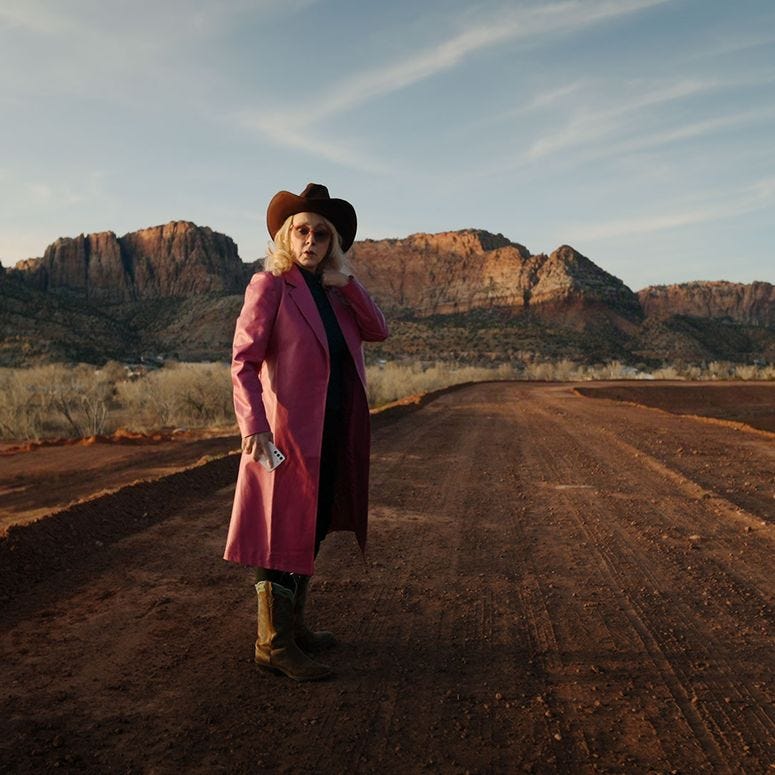
The hero of Trust Me is Christine Marie, whose background includes stints as Miss Michigan, a ventriloquist, an escape artist, and a children’s television host. After surviving a trauma1 (I’m being vague to avoid spoilers), she became a psychologist and cult researcher.
Then she moved to Short Creek, Utah, with her partner Tolga Katas, a music video director, and started volunteering to help members of the FLDS community who were facing financial hardship while their prophet, Warren Jeffs, was imprisoned.
In Short Creek, she stumbled upon a man named Samuel Bateman, who claimed to be a new prophet. Samuel had twenty-three wives, including nine under the age of eighteen.
Give your hero an external desire and a plan to achieve it
When I teach classes on memoir plus, I refer to this as the propulsive “A story” of your memoir. So you had a terrible childhood or a terrible husband or a terrible mother—what quest do you undertake in the A story? Eat, Pray, Love is not a divorce memoir; it’s a memoir about a trip around the world. Wild sold not as a grief memoir but as a solo hike memoir. Inheritance outsold Hourglass, Dani Shapiro’s marriage memoir, because Inheritance has a dramatic search at its center: who is my biological father and why did my mother lie to me my whole life? In Educated, Tara Westover must overcome extraordinary obstacles to get an education. Just Mercy is about a dramatic pursuit of justice. Adult Braces has an “A story” of a roadtrip, but the conflict in that memoir is all internal; the quest isn’t exciting.
Literary novelists really struggle with articulating their main character’s external desire. Much of the time, they are more interested in their main character’s internal wounds and conflict than in what that character is trying to do. But readers pick up novels to see how far characters will go to get what they want.
“A story doesn’t become interesting to the audience until the desire comes into play,” Truby says.
Truby helpfully provides a taxonomy of desire levels:
Survive (escape)
Take revenge
Win the battle
Achieve something
Explore a world
Catch a criminal
Find the truth
Gain love
Bring justice and freedom
Save the Republic
Save the world
In Trust Me, Christine Marie wants to help Samuel’s wives escape. Her plan is to become close to the family. She deftly strokes Samuel’s ego, telling him they’ll make a documentary about him as the prophet, so that she and Tolga can film him and his wives. She begins to collect evidence she can bring to law enforcement.
Every time she faces a setback, she comes up with a new strategy to try.
Just think about the difference between “this is a documentary [a nonfiction book, a novel] about a fundamentalist Mormon cult leader with 23 wives” and “this is a documentary [a nonfiction book, a novel] about a woman who is so committed to rescuing 23 women from a religious cult that she spends months filming a fake documentary about the cult leader, so that she can collect evidence of his crimes.”
Give your hero a moral weakness and a moral decision
In average stories, your hero is only hurting herself. (My friend Emily Stone always jokes about the heavy drinking female protagonist trope in thrillers like Girl on the Train.)
In better stories, your hero is morally flawed. She is not only hurting herself—she is hurting others. The plot is building to a crisis point when she must make a critical decision about how to behave. And her moral decision communicates something to the audience about what you, the author, believes is honorable and right.
The closer Christine Marie gets to Samuel Bateman’s wives, the more she’s in an ethical bind. To gain their trust, she has had to lie to them about her true motives.
To rescue these women, who insist they are deeply in love with Samuel, and that he is their gateway to heaven, she is going to have to totally betray them.
Watching Christine reckon with her ethical dilemma on screen is fascinating. In the pursuit of her ultimate goal, she has to make many difficult calculations about what she is and isn’t willing to do.
The stakes couldn’t be higher: if she fails, she loses the women to her opponent Samuel. If she wins, she stands to lose her relationships with all these girls and women.
My friend Penny Lane is a documentary filmmaker who recently wrote for the Criterion Channel about a documentary titled Mistress Dispeller, which has this plot:
In contemporary China, a wife hires a professional “mistress dispeller” to end her husband’s affair. [desire line!] The dispeller’s technique is to befriend both the unwitting husband and mistress under false pretenses, so she can manipulate them into breaking up. [plan!] Will the mistress be dispelled? Will the deception be revealed?
I haven’t yet seen Mistress Dispeller (after reading Penny’s essay, I really want to!), but I was struck by what Penny writes about relationship between the plot and the ethics of the film’s creation:
Part of what makes the film so riveting, at least to me, is this disorientating sense of ethical transgression.
This is of course because there is a lot of deception in the proceedings. Neither the husband nor the mistress is aware of the true motivations of the mistress dispeller, or of the filmmaking team. [Director] Lo could not be totally upfront about what they were filming—they kept it true, but vague, saying it was a documentary about modern love and dating in China. That asymmetry generates tension and dramatic irony that feels closer to fiction film than to conventional documentary. By embedding us within a process whose outcome is uncertain, Lo converts lived experience into high-stakes drama.
Takeaways for writers
If you are writing a memoir that you hope to sell to a publisher, think about whether you have an “A story” that gives you the opportunity to give your narrator an external desire. What is the reader turning the pages to find out? Will she ____ or won’t she?
Not sure if what your main character wants counts as an “external desire” or not? Ask yourself: could a director film my character doing this?
If you’re stuck on giving your hero a moral weakness, think about one of her strengths, or virtues, and push it until it becomes a problem. (Oh, she’s so great at helping others and solving their problems? What if she got in too deep solving a problem that no one asked for her help with?)
Still talking about Adult Braces
I went on the Smoke 'Em If You Got 'Em podcast to talk about Lindy West, bad boyfriends, and love addiction.
I also appeared on Emily J. Smith and Sara Petersen’s Clean Countertops podcast to talk about Adult Braces.
Upcoming Events

On Friday, April 17, I’m hosting a Chat Room conversation with Sophia Lucchesi, SVP, Head of Film and Television, at Strong Beach Productions, a full-service production company founded by Wendi McLendon-Covey and Gladys Gonzalez, to talk about the current state of the market for writers hoping their novels will be optioned by Hollywood (💎for paid subscribers only💎)
On April 21st in Darien, CT, I’m talking about being in the same writing group for ten (!) years with Kat Rosenfield and Julia Strayer. Register here (free)
On April 23rd in Winnetka, I’m interviewing musician Gaelynn Lea about her memoir IT WASN’T MEANT TO BE PERFECT. Get your ticket here!
On April 24, at 2pm ET, I’m hosting a Substack Live with Rafael Frumkin to talk about Adult Braces and Lena Dunham’s new memoir
On May 6th in Chicago, I’m interviewing debut novelist Erin Van Der Meer about her media satire THE SCOOP at Madison Street books in the West Loop! Register here
On May 12th in Chicago, I’m interviewing poet and novelist Candice Wuehle about her new Britney Spears-inspired novel ULTRANATURAL at City Lit in Logan Square! RSVP here
Truby calls this the “ghost.” Ibsen called it “sailing with a corpse in the cargo.” There are two kinds of ghosts: the most common one is something from the past that haunts the hero in the present. You can also think of the ghost as an internal opponent, something holding the hero back from taking action. The way that Christine’s ghost is revealed in the front story, through her relationship with another woman, is extremely moving.
Another great post, Leigh. I really resonate with your analysis about the documentary and Memoir writing. Thanks.
Ok, this is fascinating on many levels. I need to really ponder on this difference between memoir and novel. Structure for narrative essay or memoir has always felt so nebulous to me and I think this might unlock some things.
On a personal note, can I just say that as someone from Utah who grew up and is still a very happy and active part of the LDS community (VERY much not the same thing as FLDS) I am fascinated by these stories as much as anyone, but i also really would love to see more not-fringe Utah/LDS representation some day. It seems so often that's all we really get. (Ugh don't get me started on the Hulu "secret lives" show. I kinda wonder if that show could get away with what they're doing if it was about any other faith group). Anyway! I'll step off my soap box 🙂 Maybe I should write an essay about this ehehe.